
Supply Chain
Debate worth having: can Europe's parcel lockers ever share one network?
Louis Boroditsky — 01 October 2026
6 min read
28 October 2026
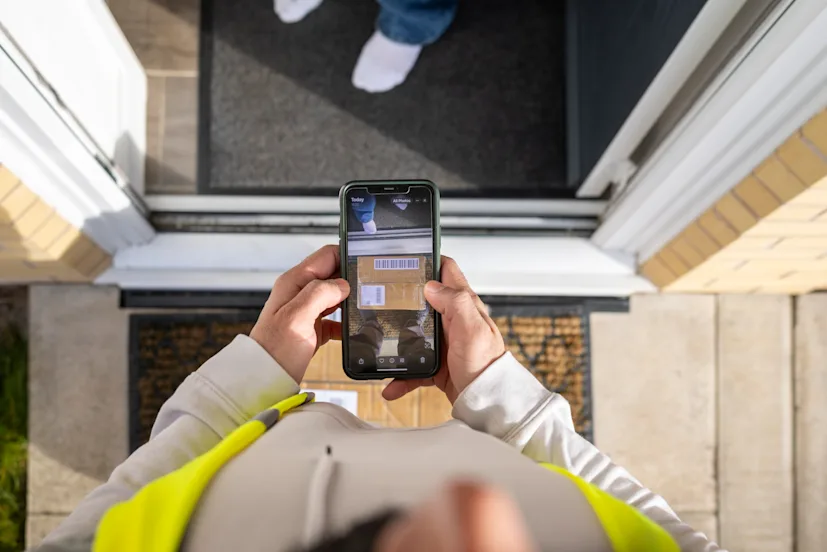
Last-mile delivery is that final journey from a local hub to the package recipient. This is the part of the trip where what started as a single route turns into many individual stops.
It's also where predicted delivery windows can start getting delayed.
In theory, moving a full truckload from warehouse to a delivery point is a controlled procedure: one route, one vehicle, one destination. Splitting that same load across dozens of doorsteps turns a single planned movement into many smaller, separate ones, each with its own address, timing and outcome.
For a delivery operations leader, that shift explains why a route that looks efficient on a map can still perform badly on the road. And it keeps getting more complicated as it gets closer to the final checkpoint.
We explore the factors causing the delays and how fleet operators can make the last-mile smoother.
Earlier in the supply chain, goods move toward a single point, such as a warehouse, a port or a regional hub. Planning that movement is relatively simple, because the destination doesn't change and the load doesn't need to be split apart.
But the last mile reverses that logic.
Multiple drop-offs and route design in congested cities and remote areas represent the most persistent last-mile delivery challenges, especially given the frequency and complexity of urban drop-offs.
A van can leave fully loaded and still lose time at every stop, because each parcel now has its own door, its own building and its own recipient.
That difference shows up directly in cost and service. Last-mile delivery costs climb not because the distance grows, but because of the number of separate stops, and the time each one demands.
Vehicle capacity and route length can provide initial ETA estimates, but they can't predict how long the driver will spend at each delivery point.
A planned route is a sequence of stops carefully planned for efficiency. But what happens at each address is something no planning can accurately predict, and a disruption at this stage overrides any initial delivery windows.
For instance, an imprecise address can take a driver several extra minutes to resolve on arrival. Those minutes compound against traffic already running behind schedule, so the van reaches its next stop later than planned.
That later arrival narrows the delivery window still open at the stop after it.
If no one is available to receive the parcel, the attempt fails, and the stop becomes more work rather than less. The driver has used time without completing the delivery, and the exception now needs rescheduling.
And yet, none of this is a routing failure in the conventional sense.
Delays such as an unclear address, a late arrival or an empty doorstep happen even when the route itself was sequenced well. The software did what it was built to do, choosing the stops efficiently. What it lacked was the information that only exists once the truck reaches the destination.
Drivers often hold location-specific knowledge—a gate code, a loading-dock quirk, a building with no doorbell—that route software was never given and cannot apply on its own. Better routing can optimize the delivery schedule, but it cannot make a recipient available or guarantee easy access to each location.
But these obstacles don't necessarily have to determine the accuracy of delivery ETAs.
It all starts with the address itself. Or, more specifically, with its geocoding. Address geocoding turns a written address into a precise, usable location, reducing the minutes a driver loses hunting for an entrance or guessing at a building number that was never quite right.
From there, multi-stop route planning sequences those locations into an order that respects delivery windows and vehicle capacity together, rather than treating distance as the only variable worth optimizing. HERE Tour Planning supports this stage, helping planners build routes around delivery commitments rather than mileage alone.
Once a van is moving, live traffic and delivery ETAs let dispatchers see when an early delay will threaten a later window, and adjust before it becomes a missed delivery rather than after.
None of this guarantees that every delivery window is met or that every attempt succeeds. For instance, a closed gate or an absent recipient still represent unpredictable factors that can affect the time it takes to make a delivery.
But better location and traffic information can give planners and dispatchers a clearer, earlier picture to act on, and that clearer picture is the improvement that is actually within their control.

Maja Stefanovic
Senior Writer
Share article
Louis Boroditsky — 01 October 2026
Louis Boroditsky — 24 August 2026
Louis Boroditsky — 04 August 2026
Get the latest on location technology, AI innovation and HERE product updates delivered straight to your inbox.
What you'll get:
Expert insights on agentic AI, spatial reasoning and location technology
Early access to HERE product updates, demos and resources
Practical guidance on building location-aware AI that works in the real world